


TANDEM: Towards a Critical Minerals Agenda for Transatlantic Relations
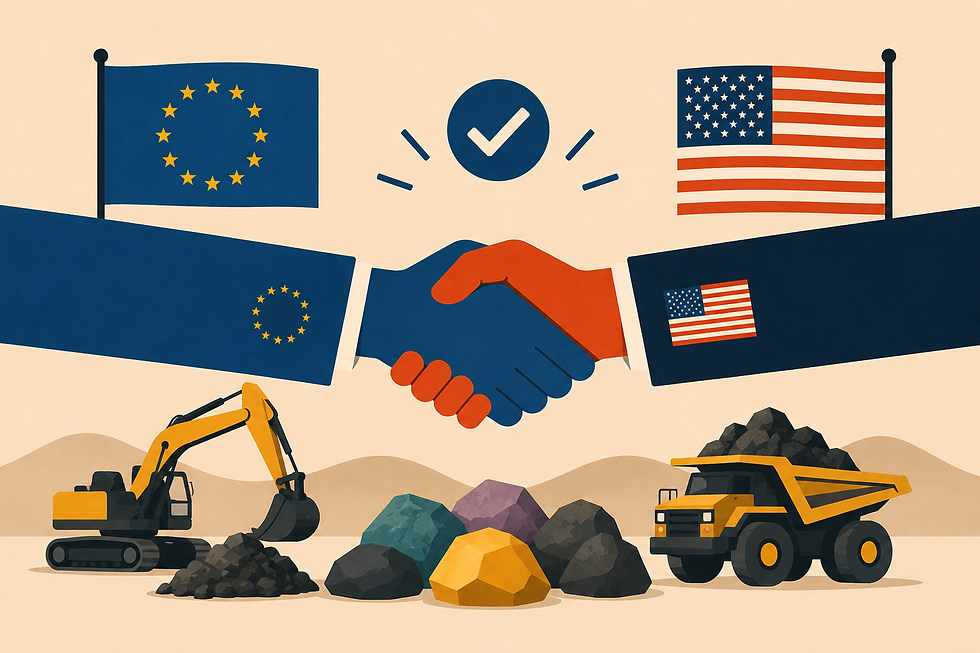
Earlier this year, Washington and Brussels finally crafted a critical minerals agreement. On 24 April, US Secretary of State Marco Rubio and European Commissioner Maroš Šefčovič signed a Memorandum of Understanding (MoU) on Critical Minerals and an EU-US Joint Action Plan. To understand how important this was for transatlantic relations, one must remember that negotiations started in late 2022 under the Biden administration but were frozen due to a lack of prioritization. Given the tumultuous state of the relationship, it is notable that both sides were willing to expend the political capital necessary to finalize the agreement. While the deal came in over a month late, first announced in an EU-US communiqué, late is better than never.
But how does the agreement enhance EU-US mineral collaboration?
The most important item in the Action Plan is the border-adjusted price floor. The concept, which has circulated in Washington policy circles for some time, would represent a radical shift for Brussels. While the deal does not directly point to a tariff dependent on the price floor, it references vague “trade measures” that could head in that direction. If implemented, such measures could neutralize China’s ability to dump prices, as tariffs would narrow the gap between artificially subsidized Chinese prices and those of Western firms operating under market conditions. Broadly defined, a border-adjusted price floor is a practice by which an importing country (the US) imposes a tariff on a specific set of goods (minerals) only to get those imports to a minimum price. The goal here is that the exporter (China), is not able to dump prices at will, as however low they might be, an adjustable tariff will ensure they get to a minimum price where they can compete with global firms. As Chad Bown explains in his podcast Trade Talks, the imbalance of state support in China is such that Western countries must consider tools in their economic arsenal for the first time. Of course, this idea shines in theory, but it is painful to implement in practice.
Read more here.


Comments